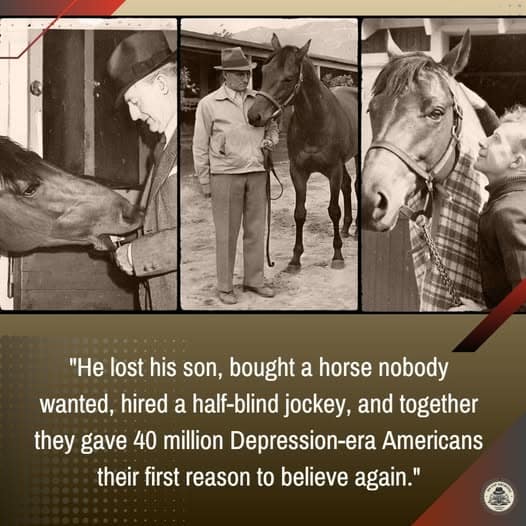
Seabiscuit

Quote from Lonnie on September 29, 2026, 4:25 PMThis was lifted from a Facebook post, and most likely written by AI. But, the story itself is true.
We need another Seabiscuit. Harness or Thoroughbred.
One in four Americans had no job. Families were sleeping in makeshift camps on the edges of cities. Children went to school hungry, if they went at all. The richest nation on earth had buckled at the knees, and nobody in Washington seemed to have an answer that worked.
Then a small, knock-kneed horse started winning races, and something shifted in the national mood that no politician had managed to move.This is a true story.
Charles Howard had built one of the most successful automobile dealerships in American history — Buick cars, California, the early decades of the twentieth century, when the automobile was remaking the country and fortunes were there to be made by the men bold enough to reach for them. Howard reached. He became wealthy beyond most people's imagination, and he seemed to have everything.
In 1926, his fifteen-year-old son Frankie was killed in a truck accident on the family's ranch in Northern California. The grief split Howard's world in half. His marriage collapsed. He was a man with money and no reason to spend it, success and nothing left to celebrate.He eventually remarried and began buying horses — not as a pastime, but as something to rebuild himself around. And in 1936, he paid $8,000 for a young horse that almost nobody else wanted.
The horse was Seabiscuit. His grandfather was Man o' War, one of the most celebrated racehorses in history, which meant the bloodline was extraordinary. The horse himself was something else entirely. He was small. His legs were oddly shaped. He had raced 35 times as a two-year-old, winning only five, and when his original owners put him up for sale at a claiming price, nobody bothered to claim him. A horse that even bargain hunters passed on.Howard's trainer, Tom Smith, had spotted something no one else could see. Smith was a quiet, unhurried man shaped by decades working with horses across the American West — not the kind of trainer who appeared in society columns or collected followers. He simply understood animals with an accuracy that bordered on instinct. He told Howard the horse was worth buying.
Then they needed a jockey.
Red Pollard had been surviving on the margins of the sport for years. He was too tall for a jockey, which meant the constant weight management was a grinding, physical ordeal. He had grown up in Canada, left behind at a racetrack by his family during the bleakest years of the Depression when they could no longer afford to keep him. He'd spent his adolescence and early adulthood riding at small tracks, sleeping in barns, taking any mount that was offered.
He was also blind in one eye. A rock had struck him during a race and destroyed the vision on his right side. He hid it for his entire career. A man with one functioning eye was making split-second decisions at forty miles an hour on an animal weighing half a ton.
When Smith introduced Pollard to Seabiscuit, the horse — usually difficult with strangers — walked directly toward him and stayed. Smith watched and made his decision. By 1937, the three of them together were winning races across the country. Crowds turned up in numbers that track officials hadn't seen in years. And those crowds weren't the wealthy patrons who had always followed racing. They were ordinary working people, or formerly working people, who stood at the railings and watched a short, ungainly horse dismiss the horses everyone had expected to win.
The country needed exactly that image. It held onto it.
In 1938, a match race was arranged against War Admiral — a Triple Crown winner, sleek and dominant, the son of the very same Man o' War who was Seabiscuit's grandfather. War Admiral's owner dictated almost every condition. His horse preferred a walking start instead of the gate. The race would be run on War Admiral's terms.
Red Pollard was recovering from a shattered leg suffered when a horse threw him earlier that year. George Woolf, a brilliantly composed jockey they called The Iceman, took the ride instead.
On November 1, 1938, an estimated 40 million Americans gathered around radios. The largest crowd in Pimlico's history filled the Baltimore racetrack. War Admiral broke fast and clean. For a moment it looked like the skeptics had been right all along.Seabiscuit caught him. Then passed him. He won by four lengths and set a new track record. The noise from the stands carried across the surrounding streets.
That year, according to press records, Seabiscuit received more newspaper coverage than any human being in America — more than Franklin Roosevelt, more than any world leader or film star or athlete. The people's horse. Named Horse of the Year 1938.Then everything fell apart at once.
Early in 1939, Seabiscuit ruptured a ligament in his foreleg. Pollard, still mending, was also sidelined. Both of them went to Howard's Ridgewood Ranch in Northern California to heal — horse and jockey spending months in quiet recovery, neither career looking likely to continue. The general verdict from racing circles was that both of them were done.
Howard and Smith refused to accept that.
Through 1939 and into 1940, they brought both back slowly. When Howard announced that Seabiscuit would attempt the Santa Anita Handicap — the race that had slipped away twice before by a single nose — the sporting press was skeptical. The horse was seven years old. He had been off the track for nearly a year.
On March 2, 1940, Red Pollard rode Seabiscuit into the starting gate at Santa Anita. 78,000 people were in the stands. The horse carried 130 pounds — a penalty weight assigned because officials considered him too dominant to race on equal terms.
He won anyway. Cleanly. Without drama. As if he had simply decided the time had come.
He retired that day and never raced again. In 89 starts he had won 33 times and earned $437,730 — a record, and 55 times what Howard had paid for him. He lived out his final years at Ridgewood Ranch, visited by thousands of fans, until he died peacefully in 1947.Four broken things had found each other in the worst decade in American economic history. A grieving father. A forgotten trainer. A half-blind jockey. A horse nobody wanted. Together they gave a nation of struggling, exhausted people something that policy and promises couldn't deliver.
Not hope as a word.
Hope as evidence.
This was lifted from a Facebook post, and most likely written by AI. But, the story itself is true.
We need another Seabiscuit. Harness or Thoroughbred.
One in four Americans had no job. Families were sleeping in makeshift camps on the edges of cities. Children went to school hungry, if they went at all. The richest nation on earth had buckled at the knees, and nobody in Washington seemed to have an answer that worked.
Then a small, knock-kneed horse started winning races, and something shifted in the national mood that no politician had managed to move.
This is a true story.
Charles Howard had built one of the most successful automobile dealerships in American history — Buick cars, California, the early decades of the twentieth century, when the automobile was remaking the country and fortunes were there to be made by the men bold enough to reach for them. Howard reached. He became wealthy beyond most people's imagination, and he seemed to have everything.
In 1926, his fifteen-year-old son Frankie was killed in a truck accident on the family's ranch in Northern California. The grief split Howard's world in half. His marriage collapsed. He was a man with money and no reason to spend it, success and nothing left to celebrate.
He eventually remarried and began buying horses — not as a pastime, but as something to rebuild himself around. And in 1936, he paid $8,000 for a young horse that almost nobody else wanted.
The horse was Seabiscuit. His grandfather was Man o' War, one of the most celebrated racehorses in history, which meant the bloodline was extraordinary. The horse himself was something else entirely. He was small. His legs were oddly shaped. He had raced 35 times as a two-year-old, winning only five, and when his original owners put him up for sale at a claiming price, nobody bothered to claim him. A horse that even bargain hunters passed on.
Howard's trainer, Tom Smith, had spotted something no one else could see. Smith was a quiet, unhurried man shaped by decades working with horses across the American West — not the kind of trainer who appeared in society columns or collected followers. He simply understood animals with an accuracy that bordered on instinct. He told Howard the horse was worth buying.
Then they needed a jockey.
Red Pollard had been surviving on the margins of the sport for years. He was too tall for a jockey, which meant the constant weight management was a grinding, physical ordeal. He had grown up in Canada, left behind at a racetrack by his family during the bleakest years of the Depression when they could no longer afford to keep him. He'd spent his adolescence and early adulthood riding at small tracks, sleeping in barns, taking any mount that was offered.
He was also blind in one eye. A rock had struck him during a race and destroyed the vision on his right side. He hid it for his entire career. A man with one functioning eye was making split-second decisions at forty miles an hour on an animal weighing half a ton.
When Smith introduced Pollard to Seabiscuit, the horse — usually difficult with strangers — walked directly toward him and stayed. Smith watched and made his decision. By 1937, the three of them together were winning races across the country. Crowds turned up in numbers that track officials hadn't seen in years. And those crowds weren't the wealthy patrons who had always followed racing. They were ordinary working people, or formerly working people, who stood at the railings and watched a short, ungainly horse dismiss the horses everyone had expected to win.
The country needed exactly that image. It held onto it.
In 1938, a match race was arranged against War Admiral — a Triple Crown winner, sleek and dominant, the son of the very same Man o' War who was Seabiscuit's grandfather. War Admiral's owner dictated almost every condition. His horse preferred a walking start instead of the gate. The race would be run on War Admiral's terms.
Red Pollard was recovering from a shattered leg suffered when a horse threw him earlier that year. George Woolf, a brilliantly composed jockey they called The Iceman, took the ride instead.
On November 1, 1938, an estimated 40 million Americans gathered around radios. The largest crowd in Pimlico's history filled the Baltimore racetrack. War Admiral broke fast and clean. For a moment it looked like the skeptics had been right all along.
Seabiscuit caught him. Then passed him. He won by four lengths and set a new track record. The noise from the stands carried across the surrounding streets.
That year, according to press records, Seabiscuit received more newspaper coverage than any human being in America — more than Franklin Roosevelt, more than any world leader or film star or athlete. The people's horse. Named Horse of the Year 1938.
Then everything fell apart at once.
Early in 1939, Seabiscuit ruptured a ligament in his foreleg. Pollard, still mending, was also sidelined. Both of them went to Howard's Ridgewood Ranch in Northern California to heal — horse and jockey spending months in quiet recovery, neither career looking likely to continue. The general verdict from racing circles was that both of them were done.
Howard and Smith refused to accept that.
Through 1939 and into 1940, they brought both back slowly. When Howard announced that Seabiscuit would attempt the Santa Anita Handicap — the race that had slipped away twice before by a single nose — the sporting press was skeptical. The horse was seven years old. He had been off the track for nearly a year.
On March 2, 1940, Red Pollard rode Seabiscuit into the starting gate at Santa Anita. 78,000 people were in the stands. The horse carried 130 pounds — a penalty weight assigned because officials considered him too dominant to race on equal terms.
He won anyway. Cleanly. Without drama. As if he had simply decided the time had come.
He retired that day and never raced again. In 89 starts he had won 33 times and earned $437,730 — a record, and 55 times what Howard had paid for him. He lived out his final years at Ridgewood Ranch, visited by thousands of fans, until he died peacefully in 1947.
Four broken things had found each other in the worst decade in American economic history. A grieving father. A forgotten trainer. A half-blind jockey. A horse nobody wanted. Together they gave a nation of struggling, exhausted people something that policy and promises couldn't deliver.
Not hope as a word.
Hope as evidence.